


President Issues Order Promulgating the 2026 Amended Petroleum Law
09:17 | 14/09/2026
According to the Ministry of Industry and Trade, the 16th National Assembly passed Petroleum Law No. 10/2026/QH16 on August 23, 2026, at its First Extraordinary Session. The Law will take effect on March 1, 2027, replacing Petroleum Law No. 12/2022/QH15.
The 2026 Petroleum Law consists of 12 chapters and 62 articles. It is structured in a logical manner, providing comprehensive coverage of entities, models and activities in the petroleum sector, while ensuring coherence between basic petroleum investigation activities and petroleum operations.
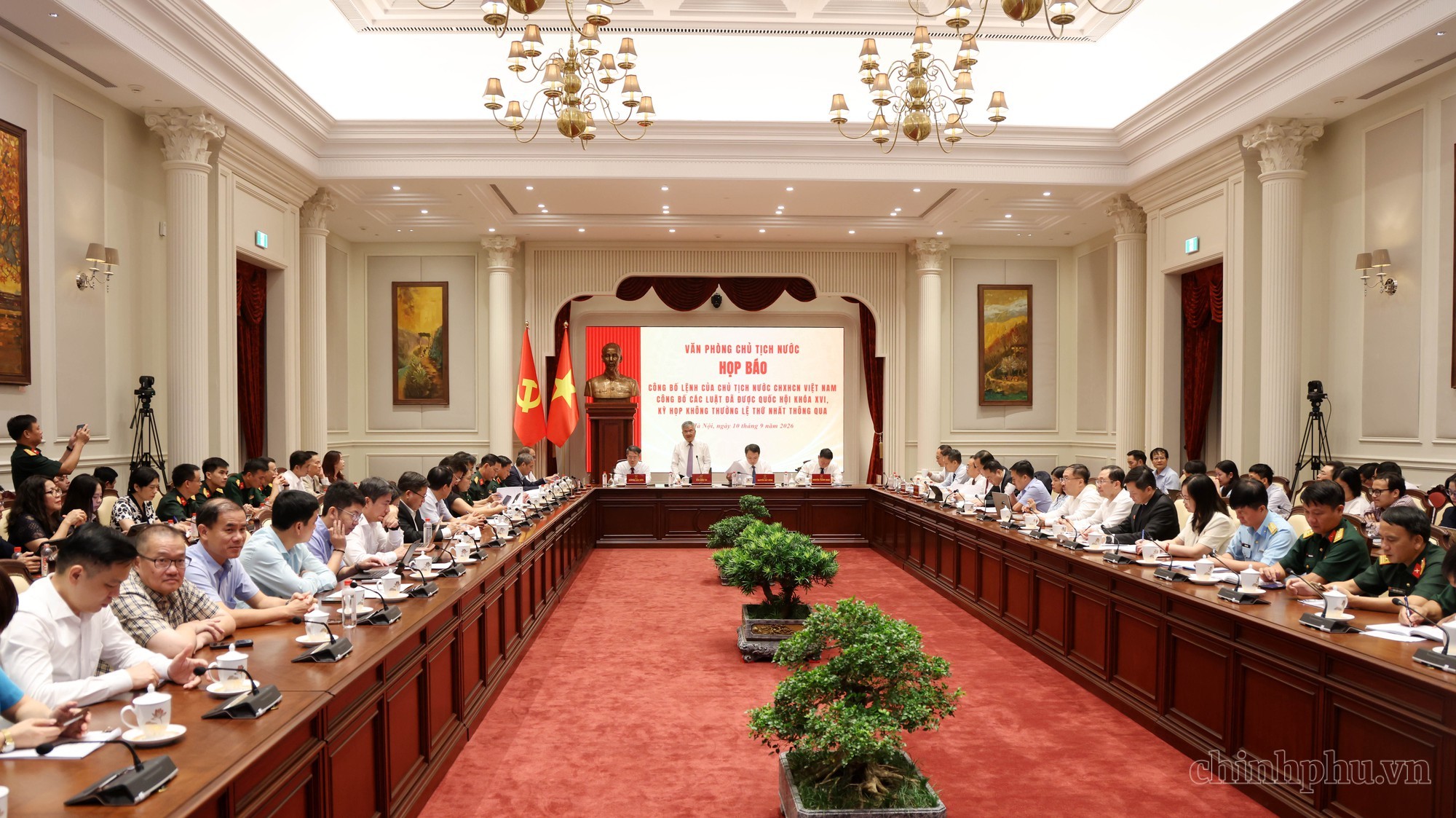 |
| Press conference announcing the President’s Order promulgating 15 laws adopted by the National Assembly at its First Extraordinary Session, held in Hanoi on September 10, 2026. Photo: Chinhphu.vn. |
The 2022 Petroleum Law was regarded as one of the country’s progressive sector-specific laws, providing a range of special mechanisms and policies that facilitated petroleum exploration, appraisal and production. Together with its implementing regulations, the law contributed to state budget revenues, socio-economic development, energy security and the protection of Viet Nam’s national sovereignty in the East Sea.
However, the petroleum sector is now facing several challenges. Production from many existing fields is declining, while most new fields are small or marginal. Exploration and appraisal activities in deepwater and offshore areas are becoming increasingly complex. Crude oil prices remain difficult to predict due to global market fluctuations, while geopolitical developments continue to affect energy supply.
In addition, certain provisions of the 2022 Petroleum Law have not kept pace with practical developments, while a number of sector-specific issues have not been adequately addressed. Advances in science and technology and the energy transition are also creating new opportunities and requirements for the development of offshore energy, carbon capture and storage (CCS), and high-tech petroleum services associated with petroleum operations.
The amendment therefore aims to strengthen the effectiveness of state management, remove regulatory barriers, improve the legal framework and enhance the attractiveness of the investment environment in the petroleum sector. It is expected to create more favorable conditions for the Vietnam National Industry-Energy Group (Petrovietnam) and petroleum contractors to increase production and investment efficiency, while contributing to the protection of national sovereignty at sea and national energy security.
Building on Existing Provisions and Introducing New Policies
First, strengthening decentralization and simplifying procedures. The Law increases the delegation of authority to state agencies responsible for petroleum management while granting additional powers to Petrovietnam. It simplifies procedures and facilitates the mobilization of resources, alongside stronger inspection and oversight. Certain matters related to national defense and security will remain subject to approval by competent authorities. The Law also clearly defines Petrovietnam’s functions and distinguishes the role of petroleum contractors from the specific functions assigned by the State.
Second, introducing additional investment incentives. As petroleum activities increasingly move into deepwater and offshore areas with complex geological conditions, high investment requirements and long payback periods, the Law introduces additional incentives to encourage the development of small and marginal fields, deepwater and offshore fields, increase petroleum recovery rates, and maximize recovery from existing fields, field clusters and petroleum blocks. These measures are intended to attract investment, increase production and contribute to the state budget.
Third, introducing policies on carbon capture and storage and offshore energy. The Law introduces regulations applicable to areas directly related to petroleum operations, including provisions on the location of carbon capture activities, responsibilities, shared use of infrastructure and safety requirements, while ensuring that such activities do not adversely affect petroleum operations. It also introduces criteria and incentives for the development of high-tech petroleum services in accordance with relevant specialized legislation.
Fourth, improving petroleum contract regulations. The regulations are revised to provide greater flexibility and protect the interests of contractors, including allowing extensions of petroleum contract terms and adjustments to work commitments under petroleum contracts.
Fifth, improving regulations on petroleum finance, accounting and costs. The Law supplements and refines provisions on accounting, auditing, financial settlement and the treatment of petroleum operating costs, taking into account the sector’s specific characteristics and international practices. It also provides for the treatment of costs when Petrovietnam performs the State’s obligations on its behalf in petroleum operations, while authorizing the Government to issue detailed regulations on a number of provisions to ensure flexibility in implementation and management.
The Ministry of Industry and Trade said that, during the drafting of the 2026 Petroleum Law, it worked closely with ministries and government agencies, the National Assembly’s Economic and Financial Committee, and other relevant organizations to ensure that the draft law was developed in accordance with the required procedures and regulations./.